Venus
The second planet from the Sun and one of the brightest objects in Earth’s night sky. Venus is often visible near sunrise or sunset and is commonly referred to as the 'morning star' or 'evening star.'
Source: solarsystem.nasa.gov
APODs including "Venus"
Venus and the Da Vinci Glow
25/03/2023
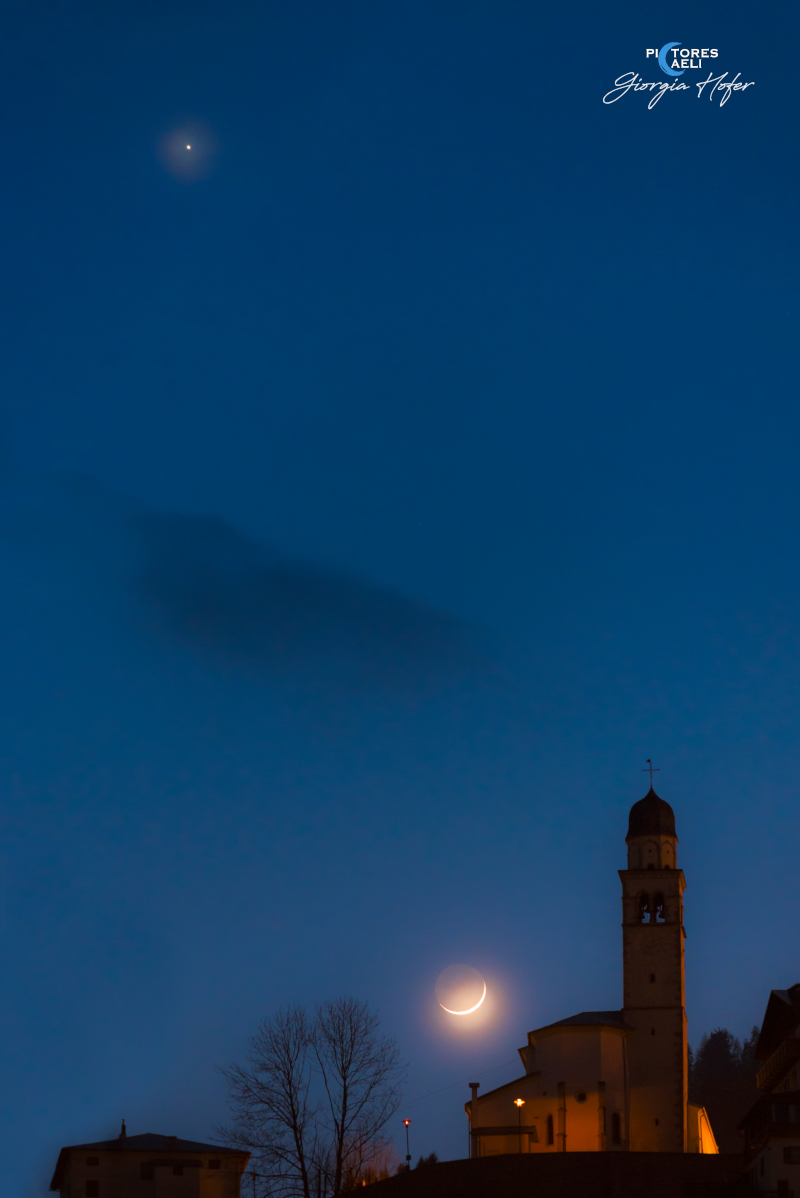
On March 23 early evening skygazers could watch Venus and a young crescent moon, both near the western horizon. On that date Earth's brilliant evening star, faint lunar night side and slender sunlit crescent were captured in this telephoto skyscape posing alongside a church tower from San Pietro di Cadore, Dolomiti, Italy. Of course the subtle lunar illumination is earthshine, earthlight reflected from the Moon's night side. A description of earthshine, in terms of sunlight reflected by Earth's oceans illuminating the Moon's dark surface, was written over 500 years ago by Leonardo da Vinci. On March 24, from some locations the Moon could be seen to occult or pass in front of Venus. Around the planet tonight, a waxing lunar crescent will appear near the Pleiades star cluster.