Venus
The second planet from the Sun and one of the brightest objects in Earth’s night sky. Venus is often visible near sunrise or sunset and is commonly referred to as the 'morning star' or 'evening star.'
Source: solarsystem.nasa.gov
APODs including "Venus"
Daytime Moon Meets Morning Star
16/11/2023
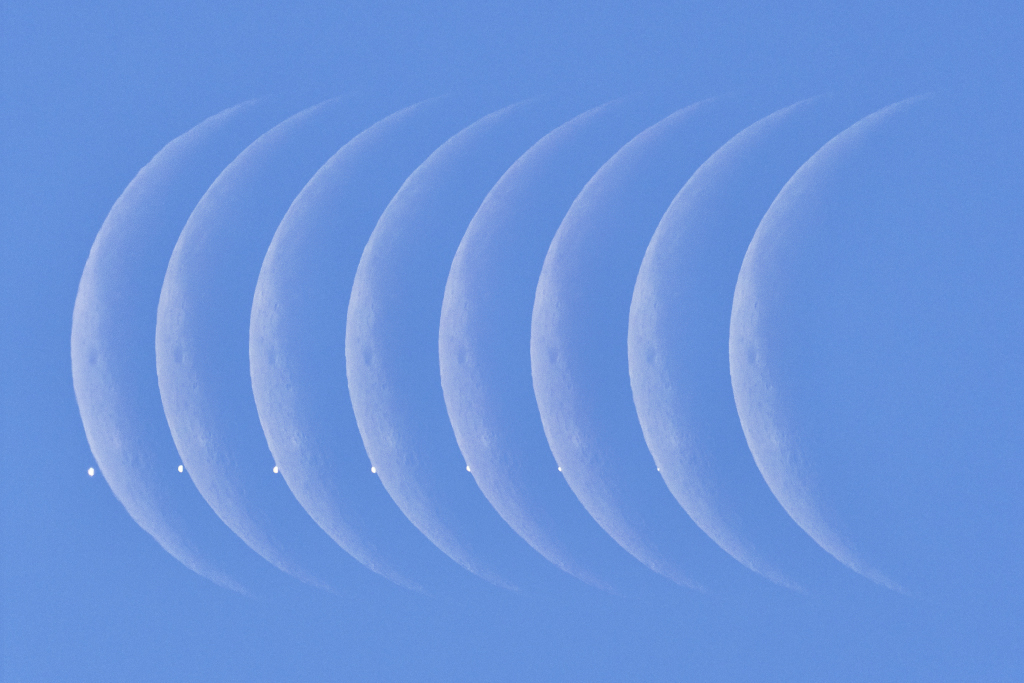
Venus now appears as Earth's brilliant morning star, shining above the southeastern horizon before dawn. For early morning risers, the silvery celestial beacon rose predawn in a close pairing with a waning crescent Moon on Thursday, November 9. But from some northern locations, the Moon was seen to occult or pass in front of Venus. From much of Europe, the lunar occultation could be viewed in daylight skies. This time series composite follows the daytime approach of Moon and morning star in blue skies from Warsaw, Poland. The progression of eight sharp telescopic snapshots, made between 10:56am and 10:58am local time, runs from left to right, when Venus winked out behind the bright lunar limb.