Voyager 2
Voyager 2 is a NASA space probe launched on August 20, 1977, to study the outer planets. It is the only spacecraft to have visited Uranus and Neptune, providing invaluable data on these planets and their moons. Voyager 2 is now in interstellar space, continuing to send data back to Earth.
Source: science.nasa.gov
APODs including "Voyager 2"
Uranus' Largest Moon: Titania
04/03/1996
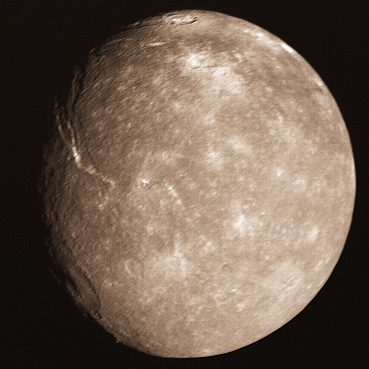
Titania's tortured terrain is a mix of valleys and craters. NASA's interplanetary robot spacecraft Voyager 2 passed this moon of Uranus in 1986 and took the above photograph. The photograph was then transmitted back to earth by radio. The valleys of Titania resemble those on Ariel indicate that Titania underwent some unknown tumultuous resurfacing event in its distant past. Although Titania is Uranus' largest moon, it is still much smaller than Triton - the largest moon of Uranus' sister planet Neptune. Titania is essentially a large dirty iceball that orbits Uranus - it is composed of about half water-ice and half rock. Titania was discovered by William Hershel in 1787. Information: The Scale of the Universe Debate in April 1996