The dense, hot core left behind after a low- or intermediate-mass star expels its outer layers. White dwarfs are composed mostly of electron-degenerate matter and no longer undergo fusion.
Image Credit: 1989 by The University of Chicago. All rights reserved.
Used by permission.
Explanation:
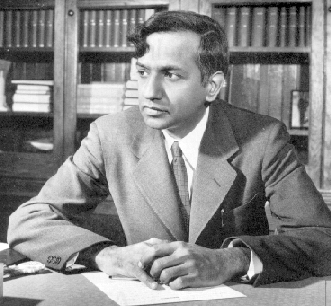
On August 21, 1995 one of the greatest astrophysicists of modern times
passed away. Subrahmanyan Chandrasekhar was a creative, prolific genius
whose ability to combine mathematical precision with physical insight
changed humanity's view of stellar physics. His most famous discovery was
that not all stars end up as
white dwarf stars,
but those retaining mass above a certain limit - today known as
"Chandrasekhar's limit," undergo further collapse. His detailed
mathematical papers and
books
on a wide variety of astrophysical subjects,
including, for example, black holes, are classic references for research at
every level. Obituaries are available from the
University
of Chicago Press and
Reuters
News Service, and a
WWW page
has been set-up to record personal memories.
Tomorrow's picture: Hot Gas and Dark Matter
| Chronological Archive
| Subject Sorted Archive
| Glossary
| Educational Links
Astronomy Picture of the Day (TM) is created and copyrighted in 1995 by
Robert
Nemiroff and
Jerry
Bonnell who are solely responsible for its content.
We are proud to acknowledge that an external review by
Point Communications
has rated Astronomy Picture of the Day in the top 5 percent of all
World Wide Web sites.
/ NASA APOD
On August 21, 1995 one of the greatest astrophysicists of modern times passed away. Subrahmanyan Chandrasekhar was a creative, prolific genius whose ability to combine mathematical precision with physical insight changed humanity's view of stellar physics. His most famous discovery was that not all stars end up as white dwarf stars, but those retaining mass above a certain limit - today known as "Chandrasekhar's limit," undergo further collapse. His detailed mathematical papers and books on a wide variety of astrophysical subjects, including, for example, black holes, are classic references for research at every level. Obituaries are available from the University of Chicago Press and Reuters News Service, and a WWW page has been set-up to record personal memories.