Wolf-Rayet star
A Wolf-Rayet star is a rare, massive, and extremely hot star characterized by strong stellar winds and significant mass loss. These stars are in a late stage of stellar evolution, often preceding a supernova explosion, and are known for their broad emission lines of ionized elements in their spectra.
Source: science.nasa.gov
APODs including "Wolf-Rayet star"
At the Edge of the Crescent Nebula
02/08/2000
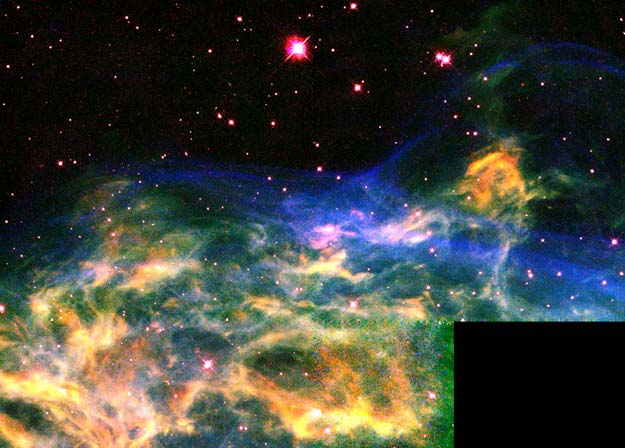
The Crescent Nebula is a rapidly expanding shell of gas surrounding a dying star. In this recently released image by the Hubble Space Telescope, a bright dynamic part of the nebula three light-years across is shown in representative color. The Crescent Nebula began to form about 250,000 years ago as central Wolf-Rayet star WR 136 began to shed its outer envelope in a strong stellar wind, expelling the equivalent of our Sun's mass every 10,000 years. This wind has been impacting surrounding interstellar gas, compacting it into a series of complex shells, and lighting it up. The Crescent Nebula, also known as NGC 6888, lies about 4,700 light-years away in the constellation of Cygnus and can only be seen through a telescope. Star WR 136 will probably undergo a supernova explosion sometime in the next million years.